 Menu
Menu

 Intermediate
Free Sweater Knitting Pattern

You can purchase this sweater from my Etsy shop.
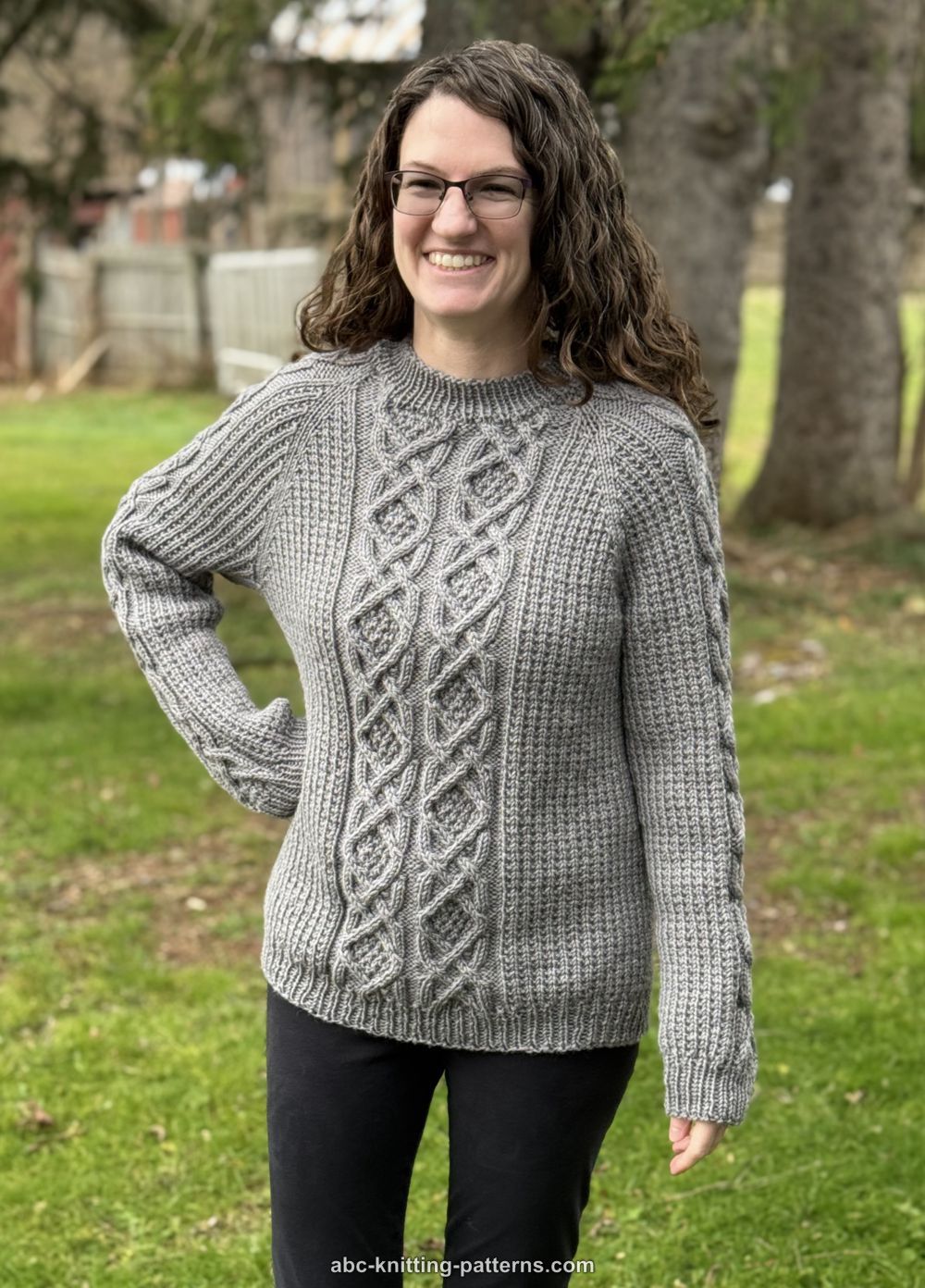
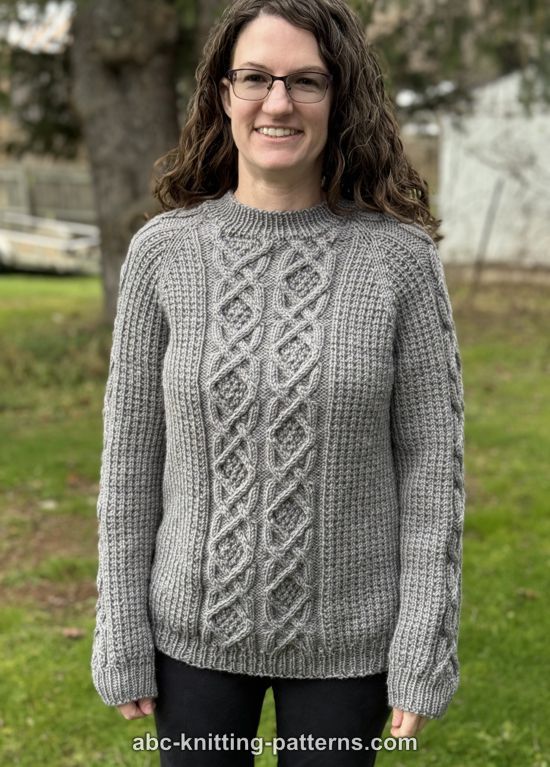
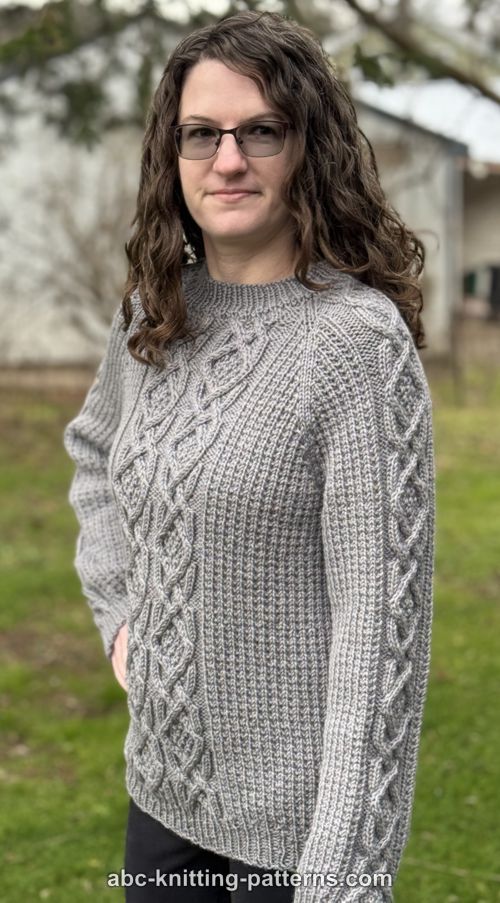
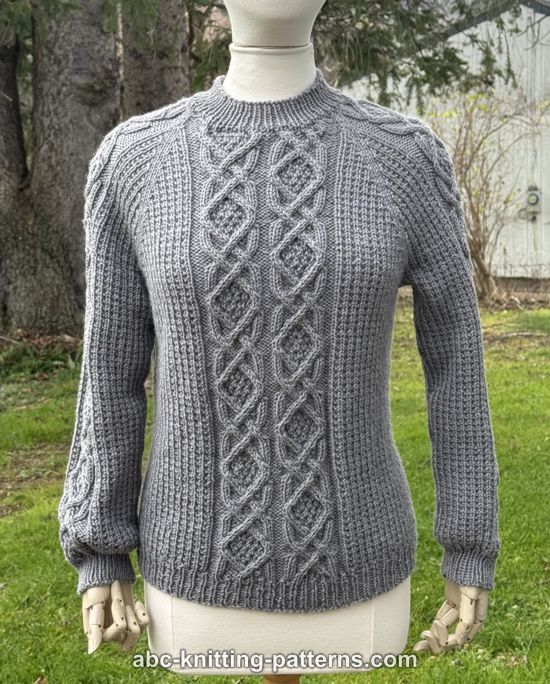
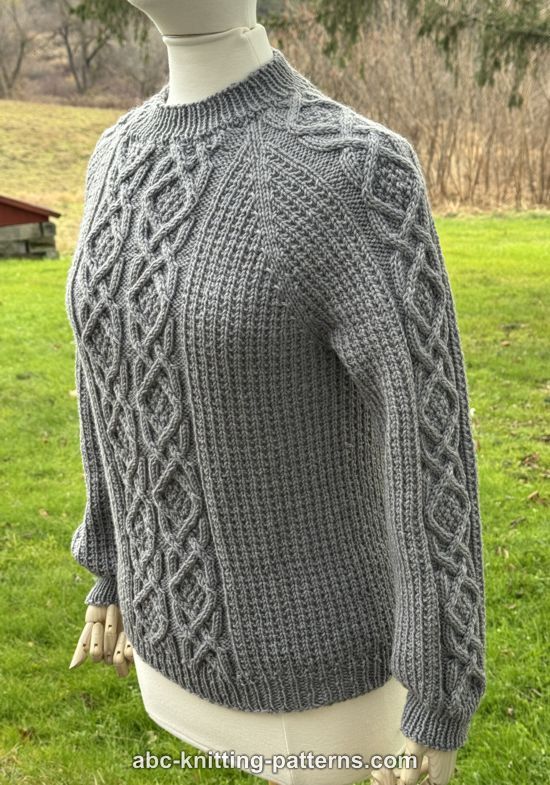
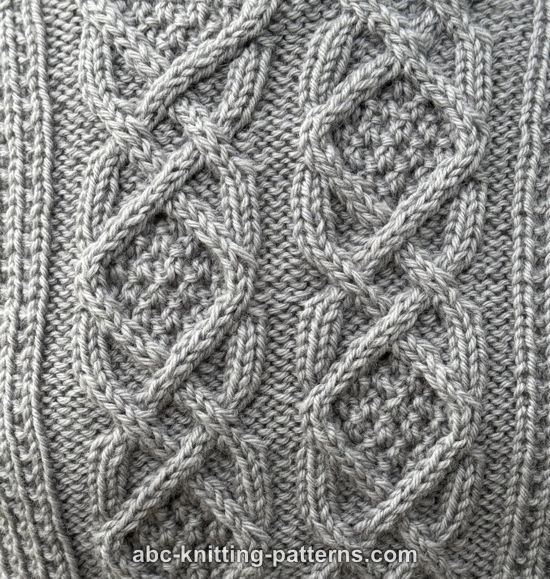
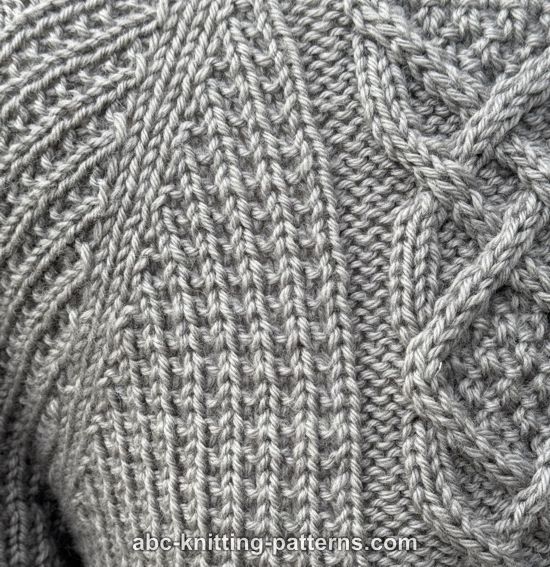
This classic cable sweater is worked entirely without seams. You begin at the top, knitting back and forth for a few rows to shape the crew neck, then join to work in the round down to the hem. The raglan increases form clean lines that frame the center cable panel, while smaller cables travel along each sleeve. When the body is complete, the sleeves are picked up and knit in the round to the same way. Simple stitches and a single repeating cable create a timeless piece you’ll reach for year after year.
Sizes: XS (S, M, L, XL, 2X)
Shown in size S with 4 inches of positive ease.
FINISHED MEASUREMENTS
Chest: 34 [38, 42, 46, 50, 54] inches (85 [95 105, 115, 125, 135] cm)
Length: 24 inches (60 cm)
Upper arm circa: 11 [12, 14, 16, 17.25, 18] inches (28 [30, 35, 40, 43, 45] cm)
Sleeve length: 18 inches (45 cm)
Skills Required/Techniques Used:
-Knit & purl, cast on & bind off
-working cables
-Increasing, decreasing
-Working in the round on double pointed needles and on circular needles
-Picking up stitches
Materials: Knit Picks (affiliate link) Wool of the Andes 100% wool worsted weight yarn 110 yards (101 meters) / 50 grams, color Silver – 12 (12, 14, 15, 16, 18) skeins.
Needles: circular US #6 (4.0 mm) 24" (60 cm) long and a set of 4-5” long double pointed needles of the same size for sleeves, or circular 16" long of the same size OR SIZE NEEDED TO OBTAIN GAUGE
Gauge in Broken Rib in the round: 19 sts x 28 rows = 4" x 4" (10 x 10 cm)
Notions:
- Stitch markers
- 2 pieces 20” long of contrasting color waste yarn to hold stitches
- Yarn needle
Abbreviations:
dpn – double pointed needles
K – knit
P – purl
St – stitch
Sts - stitches
pu&k - pick up and knit
k2tog – knit 2 together, left slant decrease
ssk – slip, slip, knit, right slant decrease
k3tog – knit 3 sts together
sl2-k1-p2sso - slip 2, knit 1, pass slipped stitches over
co – cast on
RS – right side
WS – wrong side
as est. – work as established
m 1 - make 1 increase - make a backward loop over the right-hand needle and in the next row/round purl/knit it as a regular stitch.
pm – place marker
sm – slip marker
2/2 LC: Slip next 2 stitches to cable needle and place at front of work, k2, then k2 from cable needle.
2/2 LPC: Slip next 2 stitches to cable needle and place at front of work, p2, then k2 from cable needle.
2/2 RC: Slip next 2 stitches to cable needle and place at back of work, k2, then k2 from cable needle.
2/2 RPC: Slip next 2 stitches to cable needle and place at back of work, k2, then p2 from cable needle.
2/2 LKPC: Slip next 2 stitches to cable needle and place at front of work, k1, p1, then k2 from cable needle. (marked red on the scheme)
2/2 RPKC: Slip next 2 stitches to cable needle and place at back of work, k2, then p1, k1 from cable needle. (marked light green on the scheme)
2/2 LPKC: Slip next 2 stitches to cable needle and place at front of work, p1, k1, then k2 from cable needle. (marked dark green on the scheme)
2/2 RKPC: Slip next 2 stitches to cable needle and place at back of work, k2, then k1, p1 from cable needle. (marked lilac on the scheme)
Pattern Notes
Back and Front Cable Panel (Panel 2) in Rounds
Round 1: P5, k4, p4, k4, p5, k2, (p1, k1) × 5, p1, k3, p3. (41 sts)
Round 2: P3, (2/2 RPC, 2/2 LPC) × 2, p3, 2/2 LC, (k1, p1) × 4, 2/2 RC, p3.
Round 3: P3, k2, p4, k4, p4, k2, p3, k5, (p1, k1) × 3, p1, k4, p3.
Round 4: P3, k2, p4, 2/2 RC, p4, k2, p3, k2, 2/2 LPC, (p1, k1) × 2, 2/2 RPC, k2, p3.
Round 5: P3, k2, p4, k4, p4, k2, p3, k2, p2, k2, p1, k1, p1, k3, p2, k2, p3.
Round 6: P3, k2, p2, 2/2 RKPC, 2/2 LKPC, p2, k2, p3, k2, p2, 2/2 LPC, 2/2 RPC, p2, k2, p3.
Round 7: P3, k2, p2, k3, p1, k1, p1, k2, p2, k2, p3, k2, p4, k4, p4, k2, p3.
Round 8: P3, k2, 2/2 RPKC, (p1, k1) × 2, 2/2 LPKC, k2, p3, k2, p4, 2/2 RC, p4, k2, p3.
Round 9: P3, k4, (p1, k1) × 3, p1, k5, p3, k2, p4, k4, p4, k2, p3.
Round 10: P3, 2/2 RKPC, (k1, p1) × 4, 2/2 LKPC, p3, (2/2 LPC, 2/2 RPC) × 2, p3.
Round 11: P3, k3, (p1, k1) × 5, p1, k2, p5, k4, p4, k4, p5.
Round 12: P3, k2, (p1, k1) × 5, p1, k3, p5, 2/2 LC, p4, 2/2 LC, p5.
Round 13: P3, k2, (p1, k1) × 5, p1, k3, p5, k4, p4, k4, p5.
Round 14: P3, 2/2 LC, (k1, p1) × 4, 2/2 RC, p3, (2/2 RPC, 2/2 LPC) × 2, p3.
Round 15: P3, k5, (p1, k1) × 3, p1, k4, p3, k2, p4, k4, p4, k2, p3.
Round 16: P3, k2, 2/2 LPC, (p1, k1) × 2, 2/2 RPC, k2, p3, k2, p4, 2/2 RC, p4, k2, p3.
Round 17: P3, k2, p2, k2, p1, k1, p1, k3, p2, k2, p3, k2, p4, k4, p4, k2, p3.
Round 18: P3, k2, p2, 2/2 LPC, 2/2 RPC, p2, k2, p3, k2, p2, 2/2 RKPC, 2/2 LKPC, p2, k2, p3.
Round 19: P3, k2, p4, k4, p4, k2, p3, k2, p2, k3, p1, k1, p1, k2, p2, k2, p3.
Round 20: P3, k2, p4, 2/2 RC, p4, k2, p3, k2, 2/2 RPKC, (p1, k1) × 2, 2/2 LPKC, k2, p3.
Round 21: P3, k2, p4, k4, p4, k2, p3, k4, (p1, k1) × 3, p1, k5, p3.
Round 22: P3, (2/2 LPC, 2/2 RPC) × 2, p3, 2/2 RKPC, (k1, p1) × 4, 2/2 LKPC, p3.
Round 23: P5, k4, p4, k4, p5, k3, (p1, k1) × 5, p1, k2, p3.
Round 24: P5, 2/2 LC, p4, 2/2 LC, p5, k2, (p1, k1) × 5, p1, k3, p3.
Repeat rounds 1-24.
Back and Front Cable Panel (Panel 2) in Rows
Please note that you do not work the first row of the pattern when working in rows.
Row 1: P5, k4, p4, k4, p5, k2, (p1, k1) × 5, p1, k3, p3. (41 sts)
Row 2 (RS): P3, (2/2 RPC, 2/2 LPC) × 2, p3, 2/2 LC, (k1, p1) × 4, 2/2 RC, p3.
Row 3: K3, p2, k4, p4, k4, p2, k3, p5, (k1, p1) × 3, k1, p4, k3.
Row 4: P3, k2, p4, 2/2 RC, p4, k2, p3, k2, 2/2 LPC, (p1, k1) × 2, 2/2 RPC, k2, p3.
Row 5: K3, p2, k4, p4, k4, p2, k3, p2, k2, p2, k1, p1, k1, p3, k2, p2, k3.
Row 6: P3, k2, p2, 2/2 RKPC, 2/2 LKPC, p2, k2, p3, k2, p2, 2/2 LPC, 2/2 RPC, p2, k2, p3.
Row 7: K3, p2, k2, p3, k1, p1, k1, p2, k2, p2, k3, p2, k4, p4, k4, p2, k3.
Row 8: P3, k2, 2/2 RPKC, (p1, k1) × 2, 2/2 LPKC, k2, p3, k2, p4, 2/2 RC, p4, k2, p3.
Row 9: K3, p4, (k1, p1) × 3, k1, p5, k3, p2, k4, p4, k4, p2, k3.
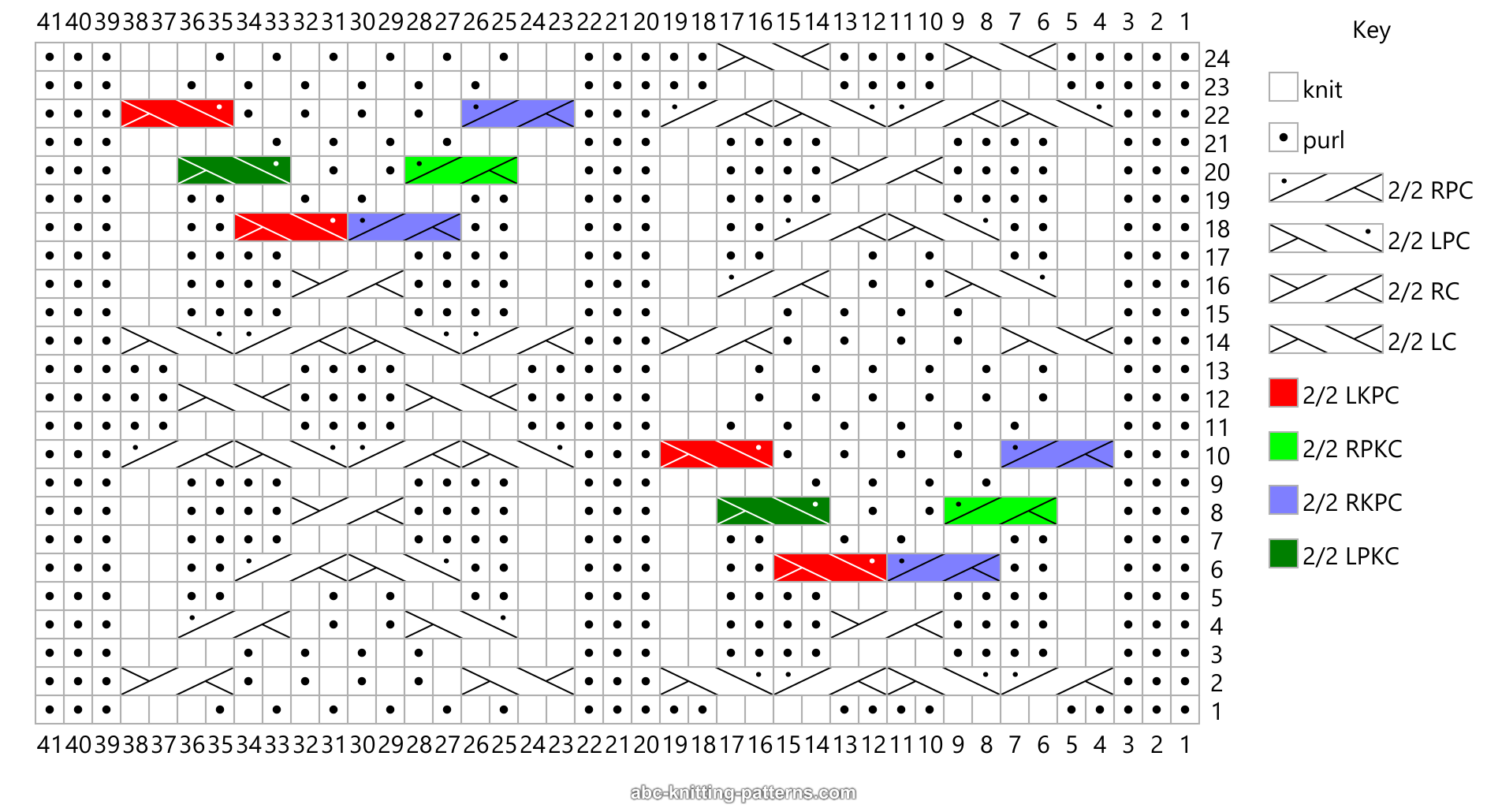
Sleeve Cable Panel (Panel 1) in Rounds
Round 1: P5, k4, p4, k4, p5. (22 sts)
Round 2: P3, (2/2 RPC, 2/2 LPC) × 2, p3.
Round 3: P3, k2, p4, k4, p4, k2, p3.
Round 4: P3, k2, p4, 2/2 RC, p4, k2, p3.
Round 5: Repeat round 3.
Round 6: P3, k2, p2, 2/2 RKPC, 2/2 LKPC, p2, k2, p3.
Round 7: P3, k2, p2, k3, p1, k1, p1, k2, p2, k2, p3.
Round 8: P3, k2, 2/2 RPKC, (p1, k1) × 2, 2/2 LPKC, k2, p3.
Round 9: P3, k4, (p1, k1) × 3, p1, k5, p3.
Round 10: P3, 2/2 RKPC, (k1, p1) × 4, 2/2 LKPC, p3.
Round 11: P3, k3, (p1, k1) × 5, p1, k2, p3.
Rounds 12 - 13: P3, k2, (p1, k1) × 5, p1, k3, p3.
Round 14: P3, 2/2 LC, (k1, p1) × 4, 2/2 RC, p3.
Round 15: P3, k5, (p1, k1) × 3, p1, k4, p3.
Round 16: P3, k2, 2/2 LPC, (p1, k1) × 2, 2/2 RPC, k2, p3.
Round 17: P3, k2, p2, k2, p1, k1, p1, k3, p2, k2, p3.
Round 18: P3, k2, p2, 2/2 LPC, 2/2 RPC, p2, k2, p3.
Round 19: Repeat round 3.
Round 20: Repeat round 4.
Round 21: Repeat round 3.
Round 22: P3, (2/2 LPC, 2/2 RPC) × 2, p3.
Round 23: Repeat round 1.
Round 24: P5, 2/2 LC, p4, 2/2 LC, p5.
Repeat rounds 1-24.
Sleeve Cable Panel (Panel1) in Rows
Please note that you do not work the first row of the pattern when working in rows.
Row 1: P5, k4, p4, k4, p5. (22 sts)
Row 2 (RS): P3, (2/2 RPC, 2/2 LPC) × 2, p3.
Row 3: K3, p2, k4, p4, k4, p2, k3.
Row 4: P3, k2, p4, 2/2 RC, p4, k2, p3.
Row 5: K3, p2, k4, p4, k4, p2, k3.
Row 6: P3, k2, p2, 2/2 RKPC, 2/2 LKPC, p2, k2, p3.
Row 7: K3, p2, k2, p3, k1, p1, k1, p2, k2, p2, k3.
Row 8: P3, k2, 2/2 RPKC, (p1, k1) × 2, 2/2 LPKC, k2, p3.
Row 9: K3, p4, (k1, p1) × 3, k1, p5, k3.
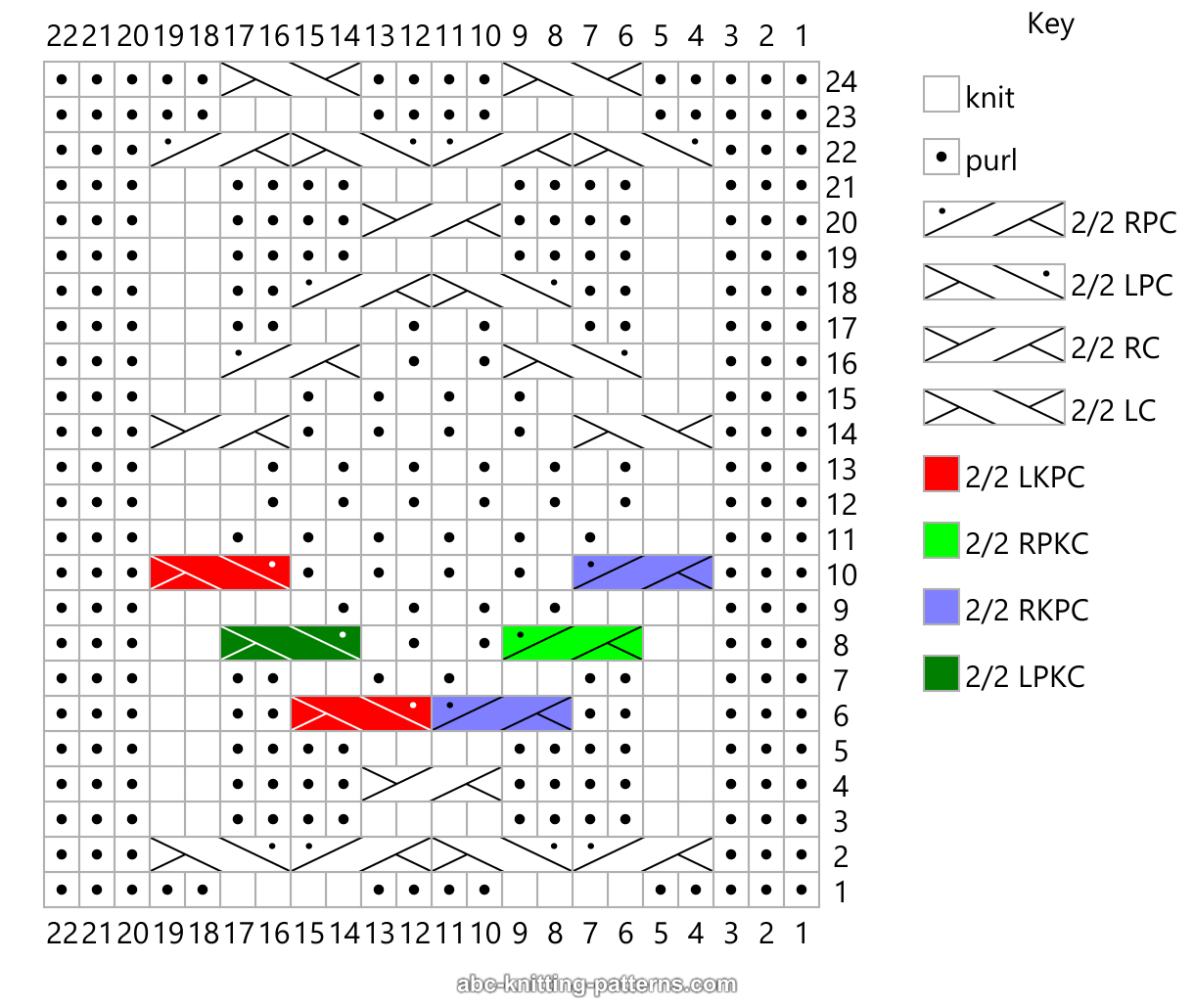
When working the cable panel, it is important to always know what round/row of the panel you are working. Always make a note of it, when you stop/pause knitting.
Broken Rib in rounds:
Odd number of sts
Round 1: k1, *p1, k1, repeat from * across the round.
Round 2: knit.
1x1 Rib in rounds: multiple of 2
*k1, p1 - repeat from * across the round. Repeat the round.
The selvedge/edge stitches are worked as follows: slip the first stitch and purl the last one.
Raglan increases: in every right side (RS) row or odd round, work till 1 st remains before the marker, m1, k1, slip marker (sm), k1, m1. There are 4 raglan lines, repeat on each raglan line, thus the number of sts in each RS row/round will increase by 8 sts.
Short Overview of the pattern
The sweater is worked top-down, first, back and forth, to shape the neck, then in-the-round, without seams. (It will be a good idea, from time to time, to transfer all your work to a couple of long circular needles and try it on to check how it fits.) The sleeves are worked in-the-round, without seam, on double pointed or circular needles. The neckline is finished with the 1x1 rib.
Sweater
Cast on 71 (79, 81, 81, 87, 89) sts and purl 1 foundation row. Count the stitches and place 4 markers as follows:
1 edge st, 1 st (left front), 2 sts (1st raglan line, pm between these 2 stitches), 14 (16, 16, 16, 18, 18) sts (left sleeve), 2 sts (second raglan line, pm between the stitches), 31 (35, 37, 37, 39, 41) sts (back), 2 sts (third raglan line, pm between the stitches), 14 (16, 16, 16, 18, 18) sts (right sleeve), 2 sts (fourth raglan line, pm between the stitches), 1 st (right front), 1 edge st.
Please note, that the panels in rows start from row 2 (see pattern notes) after cast-on and foundation row.
Row 1 (RS, increase row): sl1, m1, p1, m1, k1, slm, k1, m1, Panel 1 in rows (start with row 2, see description below), m1, k1, slm, k1, m1, Panel 2 in rows (start with row 2, see description below), m1, k1, slm, k1, m1, Panel 1 in rows (start with row 2, see description below), m1, k1, slm, k1, m1, p1, m1, p1. 81 (89, 91, 91, 97, 99) sts.
Since, the initial cast on doesn’t have enough stitches for both cable panels (22 sts for Panel 1 and 41 sts for Panel 2), see the instructions for each size below. Since you will make raglan increases in every RS row and the number of stitches will increase by 2 in each section (sleeves, back, fronts), include these extra stitches in the panel patterns as described below:
Size XS:
Sleeve Cable Panel (Panel1) in Rows
14 sts
Row 2 (RS): P3, 2/2 LPC, 2/2 RPC, p3. (14 sts)
Row 3 (WS): K4, k2, p4, k2, k4. (16 sts)
Row 4: k2, p4, 2/2 RC, p4, k2.
Row 5: p3, k4, p4, k4, p3. (18 sts)
Row 6: P1, k2, p2, 2/2 RKPC, 2/2 LKPC, p2, k2, p1.
Row 7: K2, p2, k2, p3, k1, p1, k1, p2, k2, p2, k2. (20 sts)
Row 8: P2, k2, 2/2 RPKC, (p1, k1) × 2, 2/2 LPKC, k2, p2.
Row 9: K3, p4, (k1, p1) × 3, k1, p5, k3. (22 sts)
Back and Front Cable Panels (Panel 2) in Rows
31 sts
Row 2 (RS): P2, 2/2 LPC, 2/2 RPC, 2/2 LPC, p3, 2/2 LC, (k1, p1) × 4, p2. (31 sts)
Row 3 (WS): k3, k2, p4, k4, p2, k3, p5, (k1, p1) × 3, k1, k3. (33 sts)
Row 4: k1, p4, 2/2 RC, p4, k2, p3, k2, 2/2 LPC, (p1, k1) × 2, 2/2 RPC, k1.
Row 5: P2, k4, p4, k4, p2, k3, p2, k2, p2, k1, p1, k1, p3, k2, p2. (35 sts)
Row 6: k2, p2, 2/2 RKPC, 2/2 LKPC, p2, k2, p3, k2, p2, 2/2 LPC, 2/2 RPC, p2, k2.
Row 7: P3, k2, p3, k1, p1, k1, p2, k2, p2, k3, p2, k4, p4, k4, p3. (37 sts)
Row 8: P1, k2, 2/2 RPKC, (p1, k1) × 2, 2/2 LPKC, k2, p3, k2, p4, 2/2 RC, p4, k2, p1.
Row 9: K2, p4, (k1, p1) × 3, k1, p5, k3, p2, k4, p4, k4, p2, k2. (39 sts)
Size S:
Sleeve Cable Panel (Panel1) in Rows
16 sts
Row 2 (RS): (2/2 RPC, 2/2 LPC) × 2. (16 sts)
Row 3 (WS): p3, k4, p4, k4, p3. (18 sts)
Row 4: P1, k2, p4, 2/2 RC, p4, k2, p1.
Row 5: K2, p2, k4, p4, k4, p2, k2. (20 sts)
Row 6: P2, k2, p2, 2/2 RKPC, 2/2 LKPC, p2, k2, p2.
Row 7: K3, p2, k2, p3, k1, p1, k1, p2, k2, p2, k3. (22 sts)
Row 8: P3, k2, 2/2 RPKC, (p1, k1) × 2, 2/2 LPKC, k2, p3.
Row 9: k3, p4, (k1, p1) × 3, k1, p5, k3.
Back and Front Cable Panel (Panel 2) in Rows
35 sts
Row 2 (RS): (2/2 RPC, 2/2 LPC) × 2, p3, 2/2 LC, (k1, p1) × 4, 2/2 RC. (35 sts)
Row 3 (WS): p3, k4, p4, k4, p2, k3, p5, (k1, p1) × 3, k1, p5. (37 sts)
Row 4: P1, k2, p4, 2/2 RC, p4, k2, p3, k2, 2/2 LPC, (p1, k1) × 2, 2/2 RPC, k2, p1.
Row 5: K2, p2, k4, p4, k4, p2, k3, p2, k2, p2, k1, p1, k1, p3, k2, p2, k2. (39 sts)
Row 6: P2, k2, p2, 2/2 RKPC, 2/2 LKPC, p2, k2, p3, k2, p2, 2/2 LPC, 2/2 RPC, p2, k2, p2.
Row 7: K3, p2, k2, p3, k1, p1, k1, p2, k2, p2, k3, p2, k4, p4, k4, p2, k3. (41 sts)
Row 8: P3, k2, 2/2 RPKC, (p1, k1) × 2, 2/2 LPKC, k2, p3, k2, p4, 2/2 RC, p4, k2, p3.
Row 9: K3, p4, (k1, p1) × 3, k1, p5, k3, p2, k4, p4, k4, p2, k3.
Sizes M and L:
Sleeve Cable Panel (Panel1) in Rows
16 sts
Row 2 (RS): (2/2 RPC, 2/2 LPC) × 2. (16 sts)
Row 3 (WS): p3, k4, p4, k4, p3. (18 sts)
Row 4: P1, k2, p4, 2/2 RC, p4, k2, p1.
Row 5: K2, p2, k4, p4, k4, p2, k2. (20 sts)
Row 6: P2, k2, p2, 2/2 RKPC, 2/2 LKPC, p2, k2, p2.
Row 7: K3, p2, k2, p3, k1, p1, k1, p2, k2, p2, k3. (22 sts)
Row 8: P3, k2, 2/2 RPKC, (p1, k1) × 2, 2/2 LPKC, k2, p3.
Row 9: K3, p4, (k1, p1) × 3, k1, p5, k3.
Back and Front Cable Panel (Panel 2) in Rows
37 sts
Row 2 (RS): P1, (2/2 RPC, 2/2 LPC) × 2, p3, 2/2 LC, (k1, p1) × 4, 2/2 RC, p1. (37 sts)
Row 3 (WS): K2, p2, k4, p4, k4, p2, k3, p5, (k1, p1) × 3, k1, p4, k2. (39 sts)
Row 4: P2, k2, p4, 2/2 RC, p4, k2, p3, k2, 2/2 LPC, (p1, k1) × 2, 2/2 RPC, k2, p2.
Row 5: K3, p2, k4, p4, k4, p2, k3, p2, k2, p2, k1, p1, k1, p3, k2, p2, k3. (41 sts)
Row 6: P3, k2, p2, 2/2 RKPC, 2/2 LKPC, p2, k2, p3, k2, p2, 2/2 LPC, 2/2 RPC, p2, k2, p3.
Row 7: K3, p2, k2, p3, k1, p1, k1, p2, k2, p2, k3, p2, k4, p4, k4, p2, k3.
Row 8: P3, k2, 2/2 RPKC, (p1, k1) × 2, 2/2 LPKC, k2, p3, k2, p4, 2/2 RC, p4, k2, p3.
Row 9: K3, p4, (k1, p1) × 3, k1, p5, k3, p2, k4, p4, k4, p2, k3.
Size XL:
Sleeve Cable Panel (Panel1) in Rows
18 sts
Row 2 (RS): P1, (2/2 RPC, 2/2 LPC) × 2, p1. (18 sts)
Row 3 (WS): K2, p2, k4, p4, k4, p2, k2. (20 sts)
Row 4: P2, k2, p4, 2/2 RC, p4, k2, p2.
Row 5: K3, p2, k4, p4, k4, p2, k3. (22 sts)
Row 6: P3, k2, p2, 2/2 RKPC, 2/2 LKPC, p2, k2, p3.
Row 7: K3, p2, k2, p3, k1, p1, k1, p2, k2, p2, k3.
Row 8: P3, k2, 2/2 RPKC, (p1, k1) × 2, 2/2 LPKC, k2, p3.
Row 9: K3, p4, (k1, p1) × 3, k1, p5, k3.
Back and Front Cable Panel (Panel 2) in Rows
39 sts
Row 2 (RS): P2, (2/2 RPC, 2/2 LPC) × 2, p3, 2/2 LC, (k1, p1) × 4, 2/2 RC, p2. (39 sts)
Row 3 (WS): K3, p2, k4, p4, k4, p2, k3, p5, (k1, p1) × 3, k1, p4, k3. (41 sts)
Row 4: P3, k2, p4, 2/2 RC, p4, k2, p3, k2, 2/2 LPC, (p1, k1) × 2, 2/2 RPC, k2, p3.
Row 5: K3, p2, k4, p4, k4, p2, k3, p2, k2, p2, k1, p1, k1, p3, k2, p2, k3.
Row 6: P3, k2, p2, 2/2 RKPC, 2/2 LKPC, p2, k2, p3, k2, p2, 2/2 LPC, 2/2 RPC, p2, k2, p3.
Row 7: K3, p2, k2, p3, k1, p1, k1, p2, k2, p2, k3, p2, k4, p4, k4, p2, k3.
Row 8: P3, k2, 2/2 RPKC, (p1, k1) × 2, 2/2 LPKC, k2, p3, k2, p4, 2/2 RC, p4, k2, p3.
Row 9: K3, p4, (k1, p1) × 3, k1, p5, k3, p2, k4, p4, k4, p2, k3.
Size 2X:
Sleeve Cable Panel (Panel1) in Rows
18 sts
Row 2 (RS): P1, (2/2 RPC, 2/2 LPC) × 2, p1. (18 sts)
Row 3 (WS): K2, p2, k4, p4, k4, p2, k2. (20 sts)
Row 4: P2, k2, p4, 2/2 RC, p4, k2, p2.
Row 5: K3, p2, k4, p4, k4, p2, k3. (22 sts)
Row 6: P3, k2, p2, 2/2 RKPC, 2/2 LKPC, p2, k2, p3.
Row 7: K3, p2, k2, p3, k1, p1, k1, p2, k2, p2, k3.
Row 8: P3, k2, 2/2 RPKC, (p1, k1) × 2, 2/2 LPKC, k2, p3.
Row 9: K3, p4, (k1, p1) × 3, k1, p5, k3.
Back and Front Cable Panel (Panel 2) in Rows
41 sts
Row 2 (RS): P3, (2/2 RPC, 2/2 LPC) × 2, p3, 2/2 LC, (k1, p1) × 4, 2/2 RC, p3. (41 sts)
Row 3 (WS): K3, p2, k4, p4, k4, p2, k3, p5, (k1, p1) × 3, k1, p4, k3.
Row 4: P3, k2, p4, 2/2 RC, p4, k2, p3, k2, 2/2 LPC, (p1, k1) × 2, 2/2 RPC, k2, p3.
Row 5: K3, p2, k4, p4, k4, p2, k3, p2, k2, p2, k1, p1, k1, p3, k2, p2, k3.
Row 6: P3, k2, p2, 2/2 RKPC, 2/2 LKPC, p2, k2, p3, k2, p2, 2/2 LPC, 2/2 RPC, p2, k2, p3.
Row 7: K3, p2, k2, p3, k1, p1, k1, p2, k2, p2, k3, p2, k4, p4, k4, p2, k3.
Row 8: P3, k2, 2/2 RPKC, (p1, k1) × 2, 2/2 LPKC, k2, p3, k2, p4, 2/2 RC, p4, k2, p3.
Row 9: K3, p4, (k1, p1) × 3, k1, p5, k3, p2, k4, p4, k4, p2, k3.
Row 2 (WS) and all WS rows: work the panels as instructed above, purl raglan sts and knit increased sts. For the sizes, when the number of sts exceeds the numbers, required for the whole panel (41 sts for panel 2 on the back and 22 sts for panel 1 on the sleeves) begin working Broken Rib pattern. In WS rows purl, in RS rows the 1st stitch adjoining to the panel should be knit.
Rows 3-8: Repeat rows 1-2 three more times. 111 (119, 121, 121, 127, 129) sts.
Place additional markers on both sides of the back and sleeve panels.
For size XS you don’t have yet 41 sts for the back and front panel, so work 2 more increase rounds, then place the markers.
All the stitches between cable panels and raglan increases are worked in Broken Rib pattern. The first stitch on each side of the cable panels should be knit. Include the increased raglan stitches into Broken Rib pattern.
Round 1 (RS, 1st increase round): purl to the first raglan marker, *m1, k1, sm, k1, m1 (raglan), work Broken Rib pattern till marker, work Panel 1, work Broken Rib pattern till 1 stitch remains before the next raglan marker, m1, k1, sm, k1, m1 (raglan), work Broken Rib pattern till marker, work Panel 2, work Broken Rib pattern till 1 stitch remains before the next raglan marker, m1, k1, sm, k1, m1 (raglan), work Broken Rib pattern till marker, work Panel 1, work Broken Rib pattern till 1 stitch remains before the next raglan marker, m1, k1, sm, k1, m1 (raglan), purl till the end of the row. At the end of the row cast on 21 (25, 27, 27, 29, 31) sts, join into the round and continue to work in rounds. Purl till the next raglan marker. Now the beginning of the round will be at the 1 stitch before the left front raglan marker. 140 (152, 156, 156, 164, 168) sts.
Round 2 and all even rounds: work panels as established, knit Broken Rib parts, knit raglan sts.
On the front, find the central stitch, count 20 sts on each side of it and place markers for the front cable panel.
Note: Starting with Round 3 work the Panel 2 on the front of the sweater. Start it with the same round number with which you’ve working the Panel 2 on the back.
Round 3: (2nd increase round): m1, k1, sm, k1, m1 (raglan), work Broken Rib pattern till marker, work Panel 1, work Broken Rib pattern till 1 stitch remains before the next raglan marker, m1, k1, sm, k1, m1 (raglan), work Broken Rib pattern till marker, work Panel 2, work Broken Rib pattern till 1 stitch remains before the next raglan marker, m1, k1, sm, k1, m1 (raglan), work Broken Rib pattern till marker, work Panel 1, work Broken Rib pattern till 1 stitch remains before the next raglan marker, m1, k1, sm, k1, m1 (raglan), work Broken Rib pattern till marker, work Panel 2 on the front starting with the same round you just worked on the back, work Broken Rib pattern till the end of the round. 148 (160, 164, 164, 172, 176) sts.
Repeat 2nd increase round 16 (16, 19, 23, 23, 24) more times. 276 (288, 316, 348, 356, 368) sts.
Next Round: (3rd increase round): m1, k1, sm, k1, (raglan), work Broken Rib pattern till marker, Panel 1, Broken Rib pattern till 1 st remains before the marker, k1, slm, k1, m1, work Broken Rib pattern till marker, Panel 2, Broken Rib pattern till 1 st remains before the marker, m1, k1, sm, k1, (raglan), work Broken Rib pattern till marker, Panel 1, Broken Rib pattern till 1 st remains before the marker, k1, slm, k1, m1, work Broken Rib pattern till marker, Panel 2, Broken Rib pattern till the end of the round. Note that in this increase round we increase stitches only in the back and the front. 280 (292, 320, 352, 360, 370) sts.
Repeat 3rd increase round 3 (5, 4, 4, 6, 8) more times. 292 (312, 336, 368, 384, 402) sts.
Divide for sleeves and bodice:
Make a note of the last row of the Panel 1 (sleeve cable panel) you worked.
Knit the first st. before the raglan marker, rm. Transfer left sleeve sts (all stitches between the first and the second raglan markers, rm), to a piece of waste yarn, cast on 7 (10, 12, 14, 18, 20) sts for underarm, work all the back sts as est, till the next raglan marker, transfer the right sleeve sts (all stitches between the third and the forth raglan markers, rm) to a piece of waste yarn, cast on 7 (10, 12, 14, 18, 20) sts for underarm, work all front sts as est. Place a marker in the middle of the left underarm sts to mark the beginning of the round. 186 (204, 216, 232, 246, 260) sts.
In the next rounds work the underarm sts in Broken Rib pattern.
Work as est. for 114 (118, 118, 118, 120, 120) more rounds or to desired length, taking into consideration, that there is a 2” (5 cm) 1x1 rib.
Next round: *k1, p2tog, repeat across. If the amount of stitches is odd, don’t work the last p2tog.
Next round *k1, p1, repeat across. Repeat this round ten (10) more time.
Bind off.
Sleeves
Sleeves are worked in rounds on double pointed needles or circular needles 16" long.
Transfer sleeve sts from the waste yarn to the needles and pick up 7 (10, 12, 14, 18, 20) sts over the underarm sts. Place marker in the middle of the underarm sts to mark the beginning of the round. 60 (64, 72, 82, 87, 91) sts
Slip the marker while working. Work as est for 124 (126, 128, 128, 128, 128) rounds or to desired length, taking into consideration, that there is a 2” (5 cm) 1x1 rib. Work the underarm stitches in Broken Rib pattern.
To narrow the sleeve, decrease by 2 sts on one side of the marker, alternatively, in every 12th round as follows:
Decrease round: sm, k3tog, work as est. across
The next decrease round: sm, work as est. across to 3 sts before the marker, sl2-k1-p2sso.
Next round: *k1, p2tog, repeat across. If the amount of stitches is odd, don’t work the last p2tog, just p1.
Next round *k1, p1, repeat across. Repeat this round ten (10) more time. Bind off.
Neck Rib
With the right side facing, starting with the central back st, pick up and knit (on dpn or circular needles) along the neckline even number of sts, work 12 rounds of k1, p1. Bind off.
Finishing
Weave in all yarn ends. Block.
Have fun!


| Patterns: | Knit >> Sweaters and Tops |
| Difficulty Level: | 3-Intermediate |
| Size: | 2X, L, M, S, XL, XS, |
| Technique: | Cable In-the-round Seamless Top-Down |
| Yarn Weight: | Worsted |
| Yarn Brand: | Knit Picks |